There’s been a lot of buzz around the MHT CET 2026 exam lately and for a very good reason. Starting this year, the Maharashtra Common Entrance Test (MHT CET) will be conducted twice a year. That’s right. Two attempts instead of one!
This change brings more opportunities for students aiming to secure admission in Engineering, Pharmacy, or B.Planning courses across Maharashtra. However, with double the attempts also comes double the preparation.
And where does a good preparation strategy begin? With a clear understanding of what you’re preparing for i.e. the MHT CET 2026 syllabus and marking scheme.
So, before you start solving questions or taking mock tests, let’s go over the complete syllabus of MHT CET 2026 (Std. 11th and 12th) and weightage for PCM and Biology to help you prepare strategically from day one.
MHT CET 2026 Syllabus Overview with Weightage
Once you know what MHT CET 2026 is, you can look at what you’ll actually be studying i.e. the syllabus.
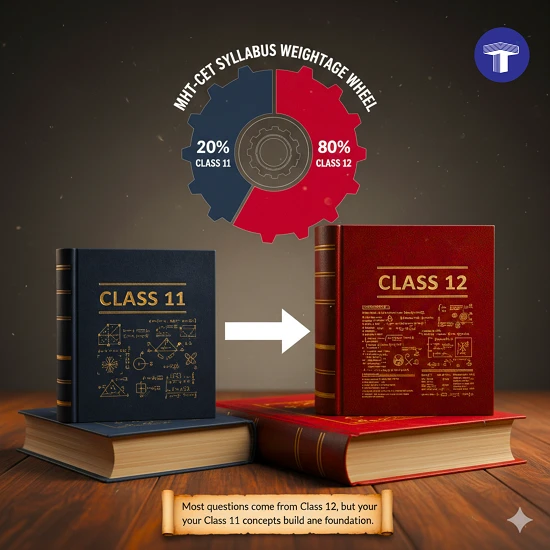
The syllabus includes chapters from Std. 11th and Std. 12th curriculum as follows:
- 20% Weightage: MHT CET 11th syllabus
- 80% Weightage: MHT CET 12th syllabus
So while MHT CET syllabus 12th topics form the bulk of your preparation, don’t ignore Std. 11th - those chapters often contain the fundamentals that tougher questions build upon.
MHT CET 2026 Syllabus Weightage: PCM vs PCB
The MHT CET 2026 syllabus weightage is largely based on the Maharashtra State Board curriculum.
MHT CET 2026 Syllabus Weightage for Physics
In the MHT CET 2026 syllabus weightage for Physics, conceptual clarity and numerical problem-solving are key.
High-Weightage Topics:
- Laws of Motion
- Current Electricity
- Magnetic Effects of Current
- Optics
- Semiconductor Electronics
- Rotational Motion
Tip: Focus more on Class 12 Physics chapters, as they dominate the paper.
MHT CET 2026 Syllabus Weightage for Chemistry
The MHT CET 2026 syllabus weightage for Chemistry is relatively balanced but leans towards theoretical understanding.
High-Weightage Topics:
- Organic Chemistry (major share)
- Chemical Thermodynamics
- Electrochemistry
- Chemical Kinetics
- Coordination Compounds
- p-Block Elements
Tip: NCERT-based questions are frequently asked, so thorough revision is essential.
MHT CET 2026 Syllabus with Weightage PCM Mathematics
The MHT CET 2026 syllabus weightage for Mathematics emphasises application-based questions.
High-Weightage Topics:
- Calculus (Differentiation & Integration)
- Probability
- Matrices and Determinants
- Vectors
- Trigonometry
Tip: Calculus alone can contribute a major chunk of marks, practice extensively.
MHT CET 2026 Syllabus with Weightage PCB Biology
For PCB students, the MHT CET 2026 syllabus weightage for Biology focuses heavily on memory-based and concept-driven questions.
High-Weightage Topics:
- Human Physiology
- Genetics and Evolution
- Ecology
- Biotechnology
- Plant Physiology
Tip: Diagrams, definitions, and NCERT line-by-line prep are extremely important.
MHT CET Syllabus Weightage 2026
MHT CET 2026 Paper Pattern and Marking Scheme
Once you’re clear on the MHT CET PCM and PCB 2026 syllabus split, it’s time to understand how marks are distributed.
The MHT CET 2026 exam will have three papers, each featuring Multiple Choice Questions (MCQs). Here’s the official structure:
| Paper | Subject | Std. 11 Questions | Std. 12 Questions | Marks per Question | Total Marks | Duration |
| Paper I | Mathematics | 10 | 40 | 2 | 100 | 90 minutes |
| Paper II | Physics | 10 | 40 | 1 | 100 | 90 minutes |
| Chemistry | 10 | 40 | 1 | |||
| Paper III | Biology | 20 | 80 | 1 | 100 | 90 minutes |
Important Highlights
- No Negative Marking: Attempt every question confidently.
- Application-Based Questions: Expect conceptual and analytical problem-solving.
- Difficulty Level:
- Physics, Chemistry, Mathematics: On par with JEE (Main)
- Biology: On par with NEET (UG)
Once you’ve understood the exam structure, the next step is knowing which MHT CET important chapters 2026 to prepare from each subject.
MHT CET 2026 Class 11 Syllabus (20% Weightage)
Here’s what you’ll be revising from your Class 11 SCERT syllabus.
Physics
The MHT CET Physics syllabus 2026 contains the following:
| MHT CET 11th Syllabus |
| Vectors: Concepts of vectors, addition, subtraction, and multiplication of vectors |
| Error Analysis: Types of errors, accuracy, precision, and significant figures |
| Motion in a Plane: Projectile motion, uniform circular motion |
| Laws of Motion: Newton’s laws, friction, circular motion dynamics |
| Gravitation: Universal law, acceleration due to gravity, Kepler’s laws |
| Thermal Properties of Matter: Heat, temperature, specific heat, calorimetry |
| Sound: Wave motion, speed of sound, Doppler effect |
| Optics: Reflection, refraction, lenses, mirrors, optical instruments |
| Electrostatics: Electric charges, Coulomb’s law, field and potential |
| Semiconductors: Intrinsic/extrinsic semiconductors, diodes, transistors |
Chemistry
Chemistry MHT CET syllabus 2026 consists of the important chapters given below:
| MHT CET 11th Syllabus |
| Some Basic Concepts of Chemistry: Mole concept, stoichiometry, laws of combination |
| Structure of Atom: Quantum mechanical model, electronic configuration |
| Chemical Bonding: Ionic, covalent, metallic bonds, VSEPR theory, hybridization |
| States of Matter (Gases and Liquids): Ideal and real gases, liquefaction |
| Redox Reactions: Oxidation numbers, balancing equations |
| Elements of Groups 1 and 2: Alkali and alkaline earth metals |
| Adsorption and Colloids (Surface Chemistry): Physisorption, chemisorption, emulsions |
| Hydrocarbons: Alkanes, alkenes, alkynes, aromatic hydrocarbons |
| Basic Principles of Organic Chemistry: Nomenclature, isomerism, effects |
| Chemistry in Everyday Life: Drugs, detergents, food additives |
Mathematics
MHT CET PCM 2026 syllabus is as follows:
| MHT CET 11th Syllabus |
| Vectors: Concepts of vectors, addition, subtraction, and multiplication of vectors |
| Error Analysis: Types of errors, accuracy, precision, and significant figures |
| Motion in a Plane: Projectile motion, uniform circular motion |
| Laws of Motion: Newton’s laws, friction, circular motion dynamics |
| Gravitation: Universal law, acceleration due to gravity, Kepler’s laws |
| Thermal Properties of Matter: Heat, temperature, specific heat, calorimetry |
| Sound: Wave motion, speed of sound, Doppler effect |
| Optics: Reflection, refraction, lenses, mirrors, optical instruments |
| Electrostatics: Electric charges, Coulomb’s law, field and potential |
| Semiconductors: Intrinsic/extrinsic semiconductors, diodes, transistors |
Biology
Std. 11 MHT CET Biology syllabus 2026 is as follows:
| MHT CET 11th Syllabus |
| Biomolecules: Carbohydrates, proteins, lipids, nucleic acids, enzymes |
| Respiration and Energy Transfer: Aerobic/anaerobic respiration, glycolysis, Krebs cycle |
| Human Nutrition: Nutrients, functions, requirements, malnutrition |
| Excretion and Osmoregulation: Excretory systems, urine formation, osmoregulation |
These topics form the foundation for your Class 12 chapters, so make sure you revisit them regularly.
MHT CET 2026 Class 12 Syllabus (80% Weightage)
Coming to the most important part, the MHT CET 12th syllabus forms 80% of the total paper. It includes the entire SCERT Maharashtra curriculum for Physics, Chemistry, Mathematics, and Biology (Academic Year 2026).
Physics
MHT CET 12th syllabus for Physics is given below:
| 12th MHT CET Syllabus Topics |
| Circular Motion: Angular displacement, velocity, acceleration, centripetal force |
| Gravitation: Gravitational potential energy, escape velocity, satellites |
| Rotational Motion: Moment of inertia, torque, angular momentum, conservation laws |
| Oscillations: SHM, damped and forced oscillations, resonance |
| Elasticity: Stress, strain, Hooke’s law, modulus of elasticity |
| Surface Tension: Molecular theory, angle of contact, capillarity |
| Wave Motion: Transverse and longitudinal waves, superposition principle |
| Stationary Waves: Formation, nodes, antinodes, harmonics |
| Wave Theory of Light: Huygens’ principle, interference, diffraction |
| Interference and Diffraction: Young’s double-slit, diffraction grating |
| Electrostatics: Capacitance, dielectrics, energy stored in capacitors |
| Current Electricity: Ohm’s law, Kirchhoff’s laws, electrical instruments |
| Magnetism: Magnetic field, Earth’s magnetism, magnetic properties |
| Electromagnetic Induction: Faraday’s laws, Lenz’s law, mutual induction |
| Electrons and Photons: Photoelectric effect, de Broglie waves, Bohr’s model |
| Atoms, Molecules, and Nuclei: Atomic models, nuclear reactions, radioactivity |
| Semiconductors: Junction diodes, rectifiers, logic gates |
| Communication Systems: Modulation, demodulation, bandwidth, satellite comm. |
Chemistry
Chemistry MHT CET syllabus 2026 is as follows:
| 12th MHT CET Syllabus Topics |
| Solid State: Crystal lattices, unit cells, packing efficiency, defects |
| Solutions and Colligative Properties: Concentration terms, Raoult’s law, boiling point elevation |
| Thermodynamics and Electrochemistry: First law, enthalpy, Gibbs energy, cells |
| Chemical Kinetics: Rate laws, order of reaction, activation energy |
| Isolation of Elements: Metallurgy, refining methods |
| P-Block Elements: Group 13–18 elements and compounds |
| D- and F-Block Elements: Transition metals, lanthanides, actinides |
| Coordination Compounds: Nomenclature, isomerism, bonding theories |
| Halogen Derivatives of Alkanes and Arenes: Preparation, properties, reactions |
| Alcohols, Phenols, and Ethers: Preparation, properties, and uses |
Mathematics
MHT CET portion 2026 for 12th Mathematics is given below:
| 12th MHT CET Syllabus Topics |
| Circular Motion: Angular displacement, velocity, acceleration, centripetal force |
| Gravitation: Gravitational potential energy, escape velocity, satellites |
| Rotational Motion: Moment of inertia, torque, angular momentum, conservation laws |
| Oscillations: SHM, damped and forced oscillations, resonance |
| Elasticity: Stress, strain, Hooke’s law, modulus of elasticity |
| Surface Tension: Molecular theory, angle of contact, capillarity |
| Wave Motion: Transverse and longitudinal waves, superposition principle |
| Stationary Waves: Formation, nodes, antinodes, harmonics |
| Wave Theory of Light: Huygens’ principle, interference, diffraction |
| Interference and Diffraction: Young’s double-slit, diffraction grating |
| Electrostatics: Capacitance, dielectrics, energy stored in capacitors |
| Current Electricity: Ohm’s law, Kirchhoff’s laws, electrical instruments |
| Magnetism: Magnetic field, Earth’s magnetism, magnetic properties |
| Electromagnetic Induction: Faraday’s laws, Lenz’s law, mutual induction |
| Electrons and Photons: Photoelectric effect, de Broglie waves, Bohr’s model |
| Atoms, Molecules, and Nuclei: Atomic models, nuclear reactions, radioactivity |
| Semiconductors: Junction diodes, rectifiers, logic gates |
| Communication Systems: Modulation, demodulation, bandwidth, satellite comm. |
Biology
MHT CET Biology syllabus 2026 for 12th is as follows:
| 12th MHT CET Syllabus Topics |
| Genetics and Evolution: Nature of gene, expression, regulation |
| Genetic Basis of Inheritance: Mendelian laws, chromosomal theory, linkage |
| Biotechnology: Genetic engineering, cloning, and industrial applications |
| Microbes in Human Welfare: Role in antibiotics, food, bioremediation |
| Plant Physiology: Photosynthesis, light and dark reactions, C3 and C4 pathways |
| Enhancement in Food Production: Plant breeding, tissue culture, biofortification |
Since most questions are application-based, focus on conceptual understanding rather than rote memorisation. Practise solving numerical problems, derivations, and case-based questions.
How to Prepare Using MHT CET Syllabus 2026
Now that you have the full picture of the MHT CET exam syllabus and pattern, let’s talk strategy.
Use concise, chapter-wise MHT CET notes that simplify key formulas and concepts, start revising with them alongside your textbooks for maximum retention.
- Prioritise Class 12 Topics: They carry the maximum weightage.
- Reinforce Class 11 Basics: Many tricky questions are built on them.
- Practise Application-Oriented Questions: Especially for Physics and Maths.
- Attempt Mock Tests Regularly: They help you manage time and reduce anxiety.
- Review Previous Year Papers: Spot frequently asked topics and question trends.
Remember: Consistency matters more than long hours. A focused two-hour study session daily is better than an unplanned all-nighter.
Final Thoughts
The MHT CET 2026 syllabus may look extensive, but it’s straightforward once you break it down.
Understand the pattern, know your weightage, and plan your preparation accordingly. Whether you’re aiming for Engineering, Pharmacy, or B.Planning, mastering the syllabus of MHT CET 2026 is your first step toward success.
Frequently Asked Questions (FAQs)
1. Has the MHT CET 2026 syllabus changed from last year?
Ans: No, the MHT CET 2026 syllabus remains the same as 2025, with questions based on the Class 11 and 12 Maharashtra Board syllabus.
2. Is the MHT CET 2026 syllabus the same as the NCERT syllabus?
Ans: It’s similar in some topics, but not identical. MHT CET follows the Maharashtra Board syllabus, not NCERT.
3. How can I download the official MHT CET 2026 syllabus PDF?
Ans: You can download the official MHT CET 2026 syllabus PDF from the State CET Cell Maharashtra website: cetcell.mahacet.org.
4. How can I prepare effectively for the MHT CET 2026 syllabus?
Ans: Focus on understanding concepts thoroughly, solve MHT CET previous year papers, and practice topic-wise mock tests regularly.
5. What is the difficulty level of the MHT CET syllabus compared to JEE Main?
Ans: MHT CET exam syllabus is generally easier than JEE Main.